
1920 Penny Value: Same Year, Different Stories
The 1920 numismatic market features mass production of copper coins in Great Britain alongside the emergence of unique varieties in Australia.
This period coincides with post-war economic stabilization, requiring a significant volume of fractional currency.
Various mints produced coins sharing an identical denomination but demonstrating a substantial difference in market 1920 penny value.
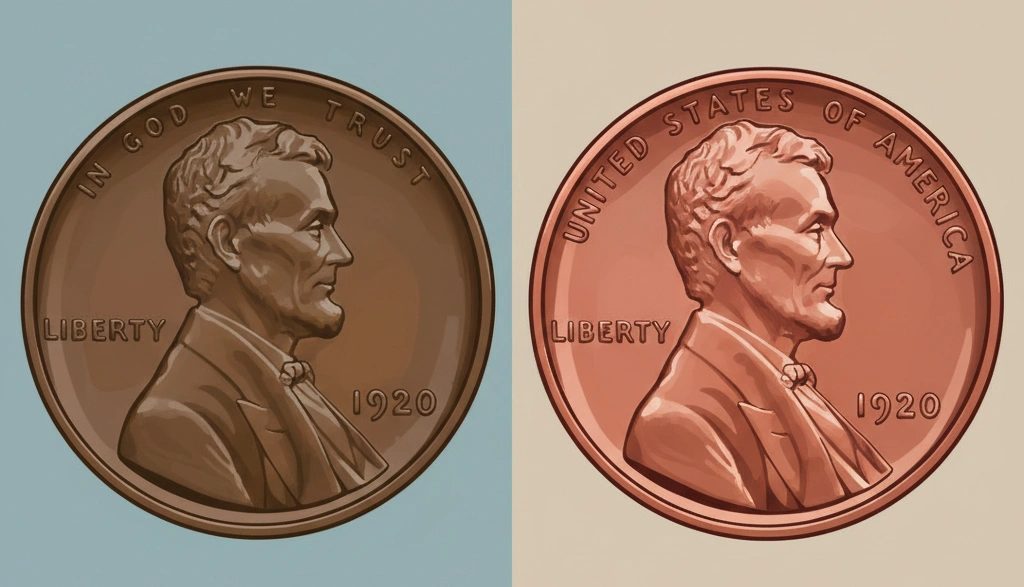
British Penny of 1920: The Royal Mint
The 1920 British penny was struck at the main London facility as well as at the private enterprises of Kings Norton Metal Co. and The Mint, Birmingham (Heaton Ltd).
The total mintage amounted to 124,693,485 specimens.
Parameter | Value |
Composition | 95% Copper, 4% Tin, 1% Zinc |
Weight | 9.45 grams |
Diameter | 30.8 millimeters |
Thickness | 1.6 millimeters |
Edge Type | Plain |
Varieties by Mint
Coins struck in London lack specific marks.
Issues from third-party mints feature small letters located to the left of the date above the coin's exergue.
No Mark: London Mint.
"H" Mark: Heaton Mint (Birmingham).
"KN" Mark: Kings Norton Metal Co.
The mintage of coins bearing the "H" mark reached 9,601,200 pieces.
The "KN" issue remains the most limited, numbering 1,120,800 specimens.
Market Value and Auction Records
The value of a standard London penny in Very Fine (VF) condition varies from 0.50 to 2 USD.
Specimens in Uncirculated condition (MS60 and higher) show a price increase of 5–8% annually depending on the preservation of natural luster.
A coin with the "KN" mark in MS63 condition sold at auction for 1,800 USD.
The average price for "KN" in Fine condition ranges between 30 and 50 USD.
The "H" issue is valued at 15–25 USD for VF preservation.
Australian Penny of 1920: Classification Complexity
Numismatists recognize the 1920 Australian penny as one of the most complex study objects due to the participation of several production sites.
Striking occurred in Sydney, Melbourne, and India (Calcutta).
Identification of Dots Below and Above the Date
The value of an Australian penny depends directly on the placement of control dots on the coin's reverse — you can check it with the coin appraisal app.
No Dots: Melbourne Mint.
Dot Under Lower Scroll: Melbourne or Sydney Mint.
Dot Above Top Scroll: Sydney Mint.
Dot Above Lower Scroll: Indian strike (Calcutta).
Dot Placement Type | Fine Condition (Price in USD) | Uncirculated Condition (Price in USD) |
No Dot | 5 - 10 | 250+ |
Dot Under Lower Scroll | 10 - 15 | 350+ |
Dot Above Top Scroll | 80 - 120 | 2,500+ |
Two Dots (Rare) | 150 - 200 | 5,000+ |
The record price for a 1920 Australian penny featuring a dot above the top scroll reached 18,000 AUD in 2021.
The annual value growth for rare Australian varieties averages 10–12%.
High-grade coins (MS64+) increase in value by up to 15% per decade.
Price Dynamics for 1920 Copper Coins
Statistical analysis of auction results over the last 20 years reveals patterns in asset valuation.
Inflationary processes affect nominal value, yet the numismatic premium remains dependent on the rarity index.
Percentage Change in Value by Grade
G-VF Category (Good - Very Fine): Growth stands at 1–2% per year, barely covering inflation.
EF-AU Category (Extremely Fine - About Uncirculated): Price increase of 4–6% annually.
MS Category (Mint State): Growth of 7–12% depending on patina and strike quality.
Finding mint errors (Double Die, Off-center) increases the price by 200–500% relative to the base condition value.
Features of Production
The year 1920 utilized steel dies subject to wear during the striking process.
Deteriorating image clarity at late striking stages reduces the specimen's collective significance.
Applying manual labor when placing mint marks led to the appearance of shifted letters and signs.
The use of bronze alloy provided durability, allowing coins to maintain detail after decades of circulation.
Chemical Composition and Preservation
Copper, being the primary alloy component, remains susceptible to oxidation when contacting aggressive environments.
The formation of stable brown patina protects the surface from further corrosion.
Possessing Red (RD) or Red-Brown (RB) mint luster increases the final valuation by 40–60%.
Entirely Brown (BN) specimens are valued according to the standard rarity scale.
1920 US Penny (Lincoln Wheat Cent)
Although the US cent is not a penny in the British sense, it is frequently included in 1920 comparative tables.
Mintage at the Philadelphia Mint totaled 310,165,000 pieces.
Issues from Denver (D) and San Francisco (S) had smaller volumes — 49,280,000 and 46,220,000 respectively.
Country | Mint | Record Price (USD) | MS65 Estimate (USD) |
Great Britain | Kings Norton (KN) | 1,800 | 1,200 |
Australia | Sydney (Dot Above) | 12,500 | 8,000 |
USA | San Francisco (S) | 48,300 | 2,500 |
A 1920-S US cent in exceptional preservation (MS66 Red) reached a price of 48,300 USD in 2008.
Standard circulated coins are valued within the 0.15–0.50 USD range.
Appraisal Procedure and Risk Factors
Determining a 1920 coin's value accurately requires using high-precision scales and optical instruments.
Detecting micro-cracks or traces of cleaning with abrasive substances reduces the market price by 50–70%.
Professional certification by PCGS or a coin value app confirms authenticity, eliminating the risks of acquiring counterfeits.
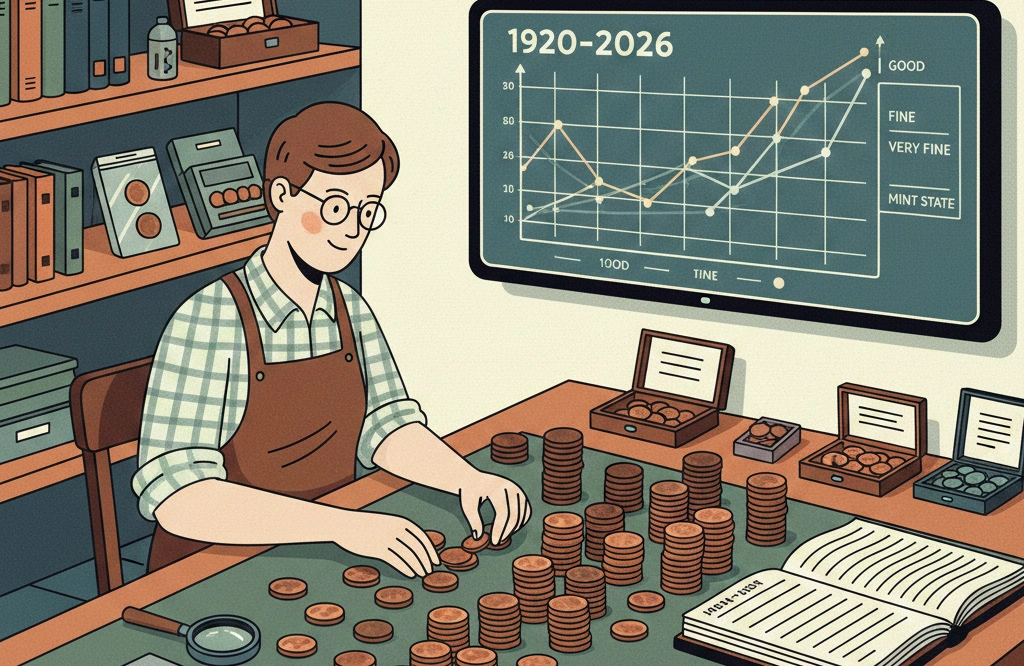
Condition Assessment Criteria
Monarch’s hair wear degree: The central part of the image wears down first.
Legend clarity: Letters must possess sharp edges.
Edge damage: Nicks and dents reduce the grade to "Details".
Field quality: Presence of hairlines indicates improper storage.
Historical Background of Mintage Formation
The conclusion of World War I necessitated replacing low-denomination paper money with metal coins.
The Melbourne Mint in 1920 began transitioning to new equipment standards.
This led to technological errors creating rare numismatic variants.
The British economy, demonstrating growth in the industrial sector, required weekly injections of millions of new coins into circulation.
By the end of 1920, the volume of copper in circulation reached a historical maximum.
Rare Mint Errors
1920 coins featuring production defects represent a distinct market segment.
Lamination error: Metal peeling due to impurities in the alloy.
Die Crack: A crack in the die reflected on the coin as a raised line.
Rotated Die: Misalignment of the obverse axis relative to the reverse by an angle exceeding 15 degrees.
The value of specimens with a 180-degree rotation exceeds 500 USD regardless of the country of origin.
The error occurrence rate in 1920 was less than 0.01% of the total output.
Using a Rarity Scale allows for classifying coins by availability.
Coin | Index (1-10) | Status |
1920 Great Britain (Plain) | 1 | Common |
1920 Great Britain (KN) | 4 | Scarce |
1920 Australia (Plain) | 2 | Available |
1920 Australia (Dot Above) | 8 | Rare |
1920 USA (S) MS65 Red | 9 | Exceptional |
Analysis shows the prevalence of Australian varieties in investment attractiveness.
Low survival rates for coins in "Red" condition for 1920 cause exponential price growth when increasing the grade.
The value difference between MS63 and MS65 can reach 400% due to a shortage of market offers.
Conclusion
The 1920 penny represents an object with a clearly defined price hierarchy.
Ignoring small details such as dots or mint marks leads to incorrect asset valuation.
Factual auction data confirms stable demand for rare positions.
Adhering to storage rules prevents surface degradation, ensuring capital preservation.
Annual price monitoring reveals a steady trend toward increasing value for early 20th-century copper coins.